Method · Zenodo DOI
Gulf–Bandari 4/4 Method
A practical and analytical framework for notating, rehearsing and programming the Bandari groove of Bandar Abbas and Hormozgan in a 4/4 working environment.
Abstract
Two layers, one groove
Many musicians describe the Bandari feel as 6/8, 12/8 or a “Khaleeji” swing. Arrangers, guitarists, educators and producers who work in a 4/4 environment need a stable way to write and program it without losing the regional groove.
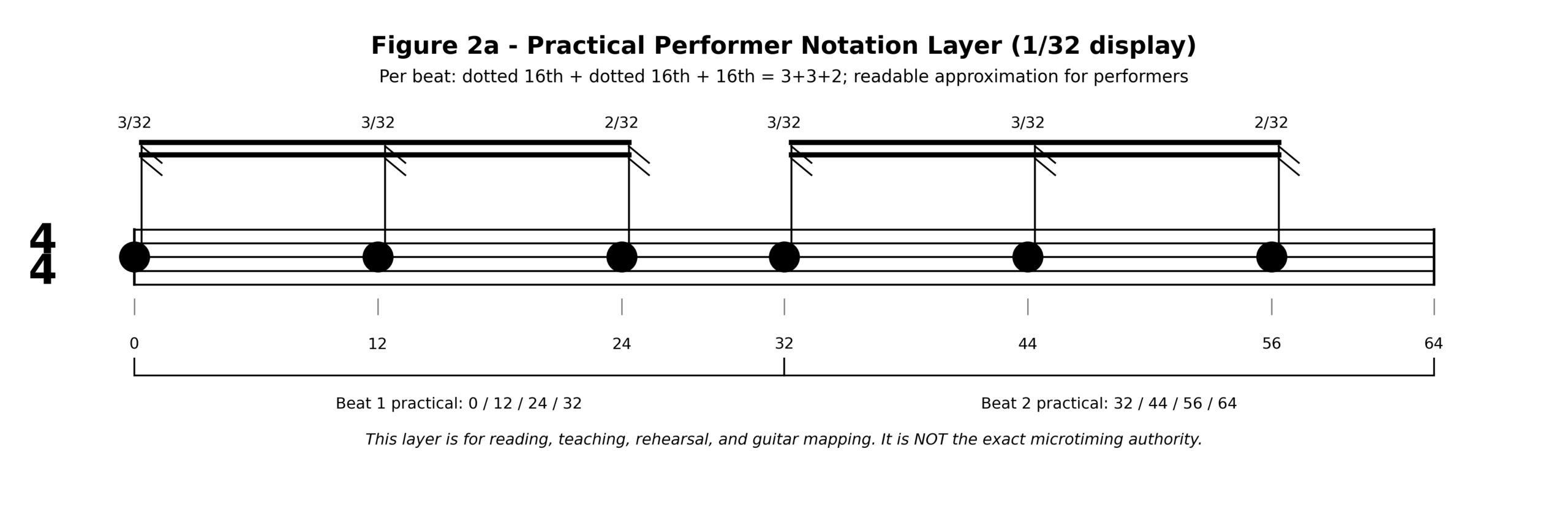
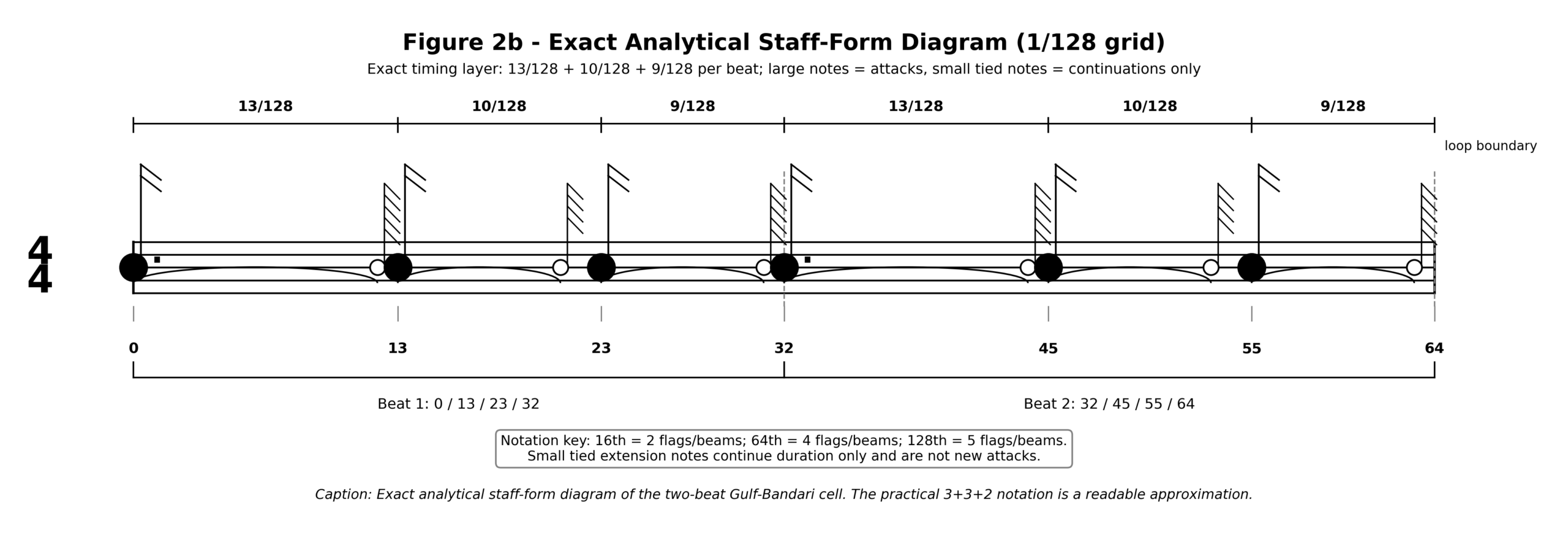
The method separates two layers. The practical layer is a performer-readable 3+3+2 grouping on a 1/32 grid, used for teaching, rehearsal and guitar mapping. The analytical layer places the three attacks of each beat at 0 / 13 / 23 / 32 on a 1/128 bar-grid, used for DAW and MIDI work.
The difference between the two layers (12 + 12 + 8 versus 13 + 10 + 9 units) is a consistent micro-timing offset of +1 / −2 / +1 per beat, about 19–20 ms per unit at 93–98 BPM.
Two-beat cycle: 0 / 13 / 23 / 32 / 45 / 55 / 64. Full 4/4 bar: 12 attacks.
| Attack | % of beat | 480 PPQ | 960 PPQ |
|---|---|---|---|
| 0 / 32 | 0% | 0 | 0 |
| 13 / 32 | 40.625% | 195 | 390 |
| 23 / 32 | 71.875% | 345 | 690 |
| 32 / 32 | 100% | 480 | 960 |
Figures
Practical and analytical notation
In practice
Guitar, ensemble and DAW
- 0 — low anchor: bass string or low muted stroke; kick or low drum (dohol).
- 13 — inner response: upstroke or high-string stroke; ghost snare, clap or rim (keser).
- 23 — closure and pickup into the next beat: high-string stroke or mute; shaker or hand percussion (pipeh).
Accents, fills and ornaments are kept on a separate layer, so the base three-attack cell stays clear. For teaching, students start with the 3+3+2 layer and meet the 0 / 13 / 23 / 32 model only as an advanced timing reference.
Scope and status
What the method is — and is not
The timing values come from the author’s repeated listening, transient-onset inspection and DAW comparison of Bandari groove segments from the Bandar Abbas / Hormozgan performance context. Live playing clusters around the model (13–14, 23–24) rather than landing on it exactly.
This is an independent, fieldwork-informed technical note. It has not been peer-reviewed. It does not claim that Bandari rhythm was invented or first documented by the author; traditional Bandari, Gulf and Southern Iranian rhythmic heritage remains collective cultural heritage.
Versions
Publication record
How to cite
Citation
@techreport{nickmanesh2026gulfbandari,
  author = {Nickmanesh, Vahid},
  title  = {Gulf-Bandari 4/4 Method -- Release v1.1: Refined
            Practical and Analytical Timing Framework},
  year   = {2026},
  type   = {Technical note},
  institution = {Zenodo},
  version = {1.1},
  doi    = {10.5281/zenodo.20694572}
}
خلاصه فارسی
متد Gulf–Bandari 4/4
این متد روشی برای نوشتن، تمرین و برنامهنویسی حس ریتم بندری (بندرعباس و هرمزگان) در قالب ۴/۴ است و دو لایه دارد. لایه اجرایی، گروهبندی ۳+۳+۲ روی شبکه ۱/۳۲ برای نوازنده و آموزش است. لایه تحلیلی، جای سه ضربه هر بخش را روی شبکه ۱/۱۲۸ در موقعیتهای ۰، ۱۳، ۲۳ و ۳۲ برای کار در DAW و MIDI مشخص میکند.
این اثر یک یادداشت فنی مستقل است که در Zenodo با شناسه DOI منتشر شده و داوری علمی نشده است. ریتم سنتی بندری میراث جمعی مردم منطقه است.